


Lot n° 42
Estimation :
30000 - 40000
EUR
Result with fees
Result
: 80 600EUR
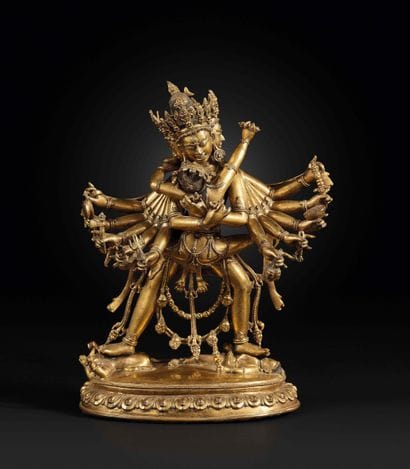
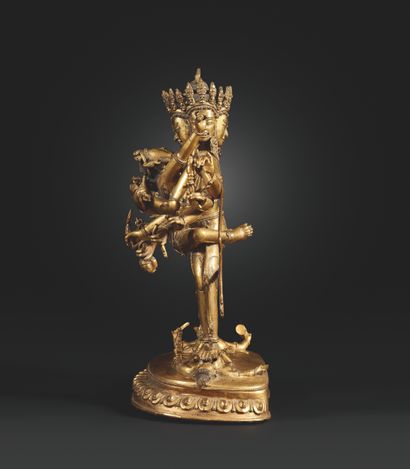
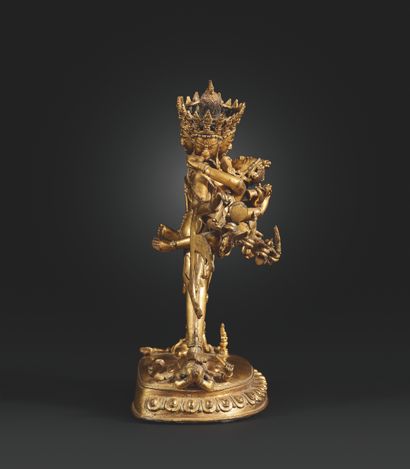
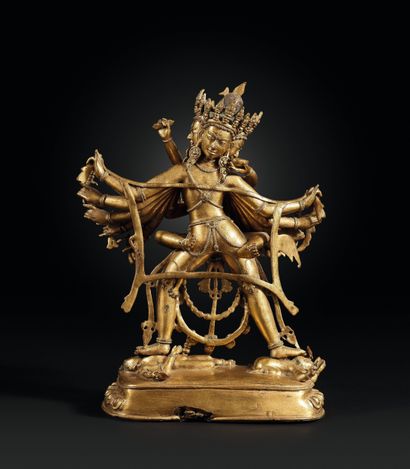
Chakrasamvara - Lot 42
Chakrasamvara
Tibet 15th century
Attributable to the workshop/school of Sonam Gyaltsen
Gilded copper alloy. H. 23 cm
An important deity in the Lamaic pantheon, Chakrsamvara can take on dozens of different
forms, from the simplest to the most complex, according to tradition and school.
Here, he is traditionally depicted coupled with his female counterpart, Vajravarahi. With his
right foot, he crushes the chest of the red Kalaratri, and with his left, the head of Yama.
With his main hands, which embrace Vajravarahi, he holds the vajra and the bell, and his two
two upper hands stretch an elephant skin over his back. The other eight hands
brandish a khatvanga, a kapala, a lasso, the four heads of Brahma, a trident, a kartrika
kartrika, axe and damaru. His waist is girded with a tiger skin. He has four heads,
each adorned with a crown of five skulls. His bun is adorned with a vishvavajra,
a crescent moon, and a jewel at the top. He wears a garland of skulls,
and a second of freshly severed heads.
Vajravarahi is coupled to him, both legs folded around his waist, which places this work
the traditions developed by the Luipa and Ganthapa mahasiddhas.
She holds a kapala in her left hand, and a vajra in her right instead of the usual kartrika.
This iconographic variation, probably related to a specific text, is attested to in both
sculpture as well as in painting, for example:
HAR Items n° 1486 (Private collection), n° 18533 (Virginia Museum of Fine Arts (Richmond),
or n° 200500 (Tibet Museum - Alain Bordier Foundation, Gruyères).
In terms of its general aesthetic, the treatment of the jewels, and the main face of the god, this
sculpture is part of the reform movement in Tibetan aesthetics that seems to have
seem to have emerged in the 1430's. Some attribute this aesthetic change to an artist
artist named Sonam Gyaltsen, as his name appears on two major works,
a large Avalokiteshvara created for the Jamchen Chode monastery in the province of
(HAR item no. 61516) with a dedication to two leaders of the Rinpung clan, and a Shri Devi from the seventh
a Shri Devi from the seventh Tashigomang of Densatil, built in 1431-1432 (HAR item no. 1829).
It's interesting to note that this artistic reform movement coincides perfectly
with the shift in political power between the declining Phagmodrupa dynasty and their
relatives and ministers of the Rinpungpa clan.
Provenance :
- Galerie Marco Polo (Paris)
- Acquired from the latter by its current owners on October 7, 1987.
My orders
Sale information
Sales conditions
Return to catalogue